Attention Deficit Hyperactivity Disorder (ADHD) is often misunderstood as a childhood phase or a simple lack of discipline. The truth is otherwise.
In reality, it is a complex neurodevelopmental condition that affects how the brain processes information, manages time, and regulates emotions. While the term ADD – Attention Deficit Disorder is still used informally, it is technically a subtype of ADHD.
Identifying these symptoms is the first step toward reclaiming control over your daily life. This blog is a guide about the nuances of how these symptoms manifest across different ages and types. Are you ready to know if you have any of the ADD and ADHD Symptoms?
Buckle up and continue reading.
The Hidden Patterns Behind ADD and ADHD
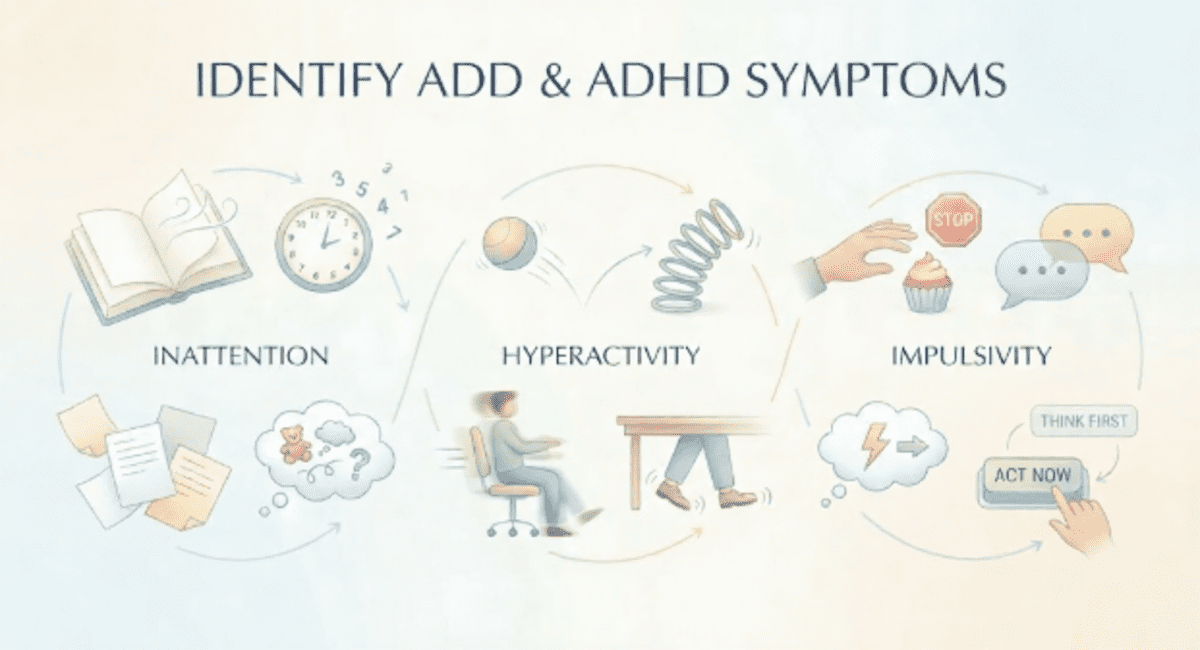
ADD and ADHD are parts of the same condition, but people often use them to describe different patterns. ADD usually refers to the inattentive type, where someone struggles with focus, forgets things easily, and seems lost in thought rather than restless.
ADHD is the modern term and includes hyperactive and impulsive behaviors, like fidgeting, blurting out answers, or acting without thinking. In short, ADD looks quiet and distracted, whereas ADHD looks restless and energetic. But there are a few common things:
Both disorders are neurodevelopmental.
Both affect how the brain manages attention, focus, and self-control.
Experts have found a neat way to boil down the difference into two simple equations.
- ADD = Inattention + Forgetfulness + Disorganization
- ADHD = Inattention + Hyperactivity + Impulsivity
What Are the 3 Primary Presentations Of ADHD?
Medical professionals categorize ADHD into three distinct types based on the dominant symptoms present. It is important to know in which category a person lands to help tailor the approach of management and support for them.
-
Predominantly Inattentive (Formerly ADD)
In this condition, individuals have significant trouble finishing tasks. They also find it tough to follow instructions and to stay organized. Experts have also observed that these patients will often be daydreamers and may not show the typical hyper behaviors.
-
Predominantly Hyperactive-Impulsive
This presentation is characterized by constant movement, fidgeting, and an inability to wait one’s turn. It is often the easiest type of ADD and ADHD Symptoms to spot in a classroom.
-
Combined Presentation
The third one is the most common diagnosis. In this, the individual displays a significant mix of both inattentive and hyperactive symptoms. Thus, the name: combined presentation.
How Do Inattentive Symptoms Appear in Daily Life?
There is a set of inattentive symptoms, too, and it is not easy to recognize them. Why? Obviously, because they don’t always disrupt a room. They just keep on going undiagnosed frequently, especially in girls and high-achieving adults. So, if you or someone you know struggles with the following, it may be an indication of the inattentive type.
- The mind feels an internal fog. It is the feeling where one’s brain works like a browser with 50 tabs open, but the victim is still unable to find which one is playing music. This condition is not favorable for research and essay writers. They will have a hard time collecting ideas and penning them down.
- One may also suffer from selective sustained attention. This is when a person can spend six hours on a video game or a skill (hyperfocus), but can’t focus on a short email.
- Next up is the executive dysfunction. This involves a total breakdown in starting. The victim knows that they need to complete a certain task, like washing a cup. They even want to do that task, but they feel physically paralyzed and unable to move towards it.
- The last inattentive symptom of ADHD is object permanence issues. If an item is out of sight, it ceases to exist. Yes, it is as simple as that. If you can’t see it, it is probably not there. This leads to lost keys, forgotten appointments, and clutter piles that act as visual reminders. It also links to the constant emotional reassurance needed in some cases.
What Does Hyperactivity and Impulsivity Look Like Beyond Childhood
While we often picture a young boy running around a classroom, hyperactivity doesn’t always mean the same thing at all ages. For instance, in adults, it often transforms into a mental or social restlessness rather than physical running.
- It could be physical fidgeting, where a person taps their feet, clicks a pen, or has the constant need to be doing something with their hands.
- One might be verbally impulsive and would interrupt others during conversation or finish people’s sentences because the wait feels physically uncomfortable.
- Emotional dysregulation is also a form of adult hyperactivity. One might feel emotions more intensely than others. A small rejection can feel like a devastating blow, such as the Rejection Sensitive Dysphoria, or RSD.
- It could also be low impulse control, which means they keep making snap decisions about finances, diet, or lifestyle, without considering long-term costs.
Read Also: The Invisible Struggle: Mental Health and Disability
How Do Symptoms Differ Between Children and Adults
The core of the disorder remains the same, but the environment changes how the symptoms are expressed.
-
Symptoms in Children
In kids, ADHD often looks like trouble in school. Teachers may report that the child is bright but lazy or disruptive. Some other signs can also be:
- Difficulty following multi-step directions.
- Losing school supplies or homework constantly.
- Inability to wait for their turn in games.
-
Symptoms in Adults
In adults, the attention deficit looks like trouble with life management. This is because the support provided by parents and teachers is gone, and the internal struggle becomes clearer. You will often find such adults searching for Business, English, or nursing assignment help in Ireland because the disorder makes daily tasks tougher to handle. Some other signs can also be:
- Chronic lateness or time blindness (underestimating how long a task takes).
- Career hopping or feeling stuck despite having high potential.
- Difficulty maintaining relationships due to perceived forgetfulness or not listening.
Why Is ADHD Often Missed in Women and Girls
For decades, the diagnostic criteria for ADHD were based on the behavior of young boys. However, research now shows that girls often present differently. For example, instead of being hyperactive, girls are more likely to be inattentive.
They may work twice as hard to mask their symptoms, which makes them extremely exhausted, anxious, and depressed. A girl with ADHD might not be the one running around the room. She might be the one staring out the window, quietly losing her place in the textbook.
What Are the Main Differences in Symptoms?
The biggest point of confusion is that ADD (Attention Deficit Disorder) is no longer a separate medical diagnosis. It is actually a subtype of ADHD (Attention Deficit Hyperactivity Disorder).
In 2026, doctors use ADHD as the umbrella term for three different ways the condition shows up. We have already explained them above, so now let us move on to separating them. Note: The distinction comes down to how the energy is expressed:
- Internally (inattentive)
- Externally (hyperactive)
| Feature | Inattentive ADHD (formerly ADD) | Hyperactive-Impulsive ADHD |
| Energy Level | Appears quiet, or zoned out | Appears restless |
| Main Struggle | Staying on task and retaining details | Sitting still and waiting for a turn |
| Social Signal | Often missed. Seen as shy or lazy | Often noticed. Seen as disruptive |
| Internal State | Mental fog or racing thoughts | Physical urge to move or speak |
FAQs
Does ADHD affect your sleep?
Yes. Many people with this condition experience a tired but wired brain at night. This makes it difficult to shut off thoughts and fall asleep.
Is hyperfocus actually a symptom?
Yes. ADHD isn’t just a lack of focus; it is also an inability to regulate it. You may intensely focus on one hobby for hours while ignoring basic needs.
Does diet impact ADHD symptoms?
While food doesn’t cause it, high-protein meals can help brain function. The sugary snacks, however, may cause spikes and crashes that make focus much harder.
Managing Symptoms is Tough
Identifying the symptoms is only the beginning. Once you know what you are dealing with, you can implement strategies that work with your brain chemistry rather than against it.
However, this is not a job for you alone. You need professional guidance for recognizing and dealing with your ADD and ADHD Symptoms. Once you have identified the signs, do not expect healing to come to you in the same night. You have to peel layers of shame and realize that your struggles aren’t a character flaw. They are rather a neurological reality.